Koh Samui, Phangan and Tao: the island rate penalty, and how to avoid it
Article updated: 2026-09-17
Best rate USD · Bangkok: 33.24 — Superrich Thailand — Headquarter Rajdamri 1 · Sep 20, 08:58 → Details
There is a reliable pattern to money on Thai islands, and it is not a scam. It is logistics.
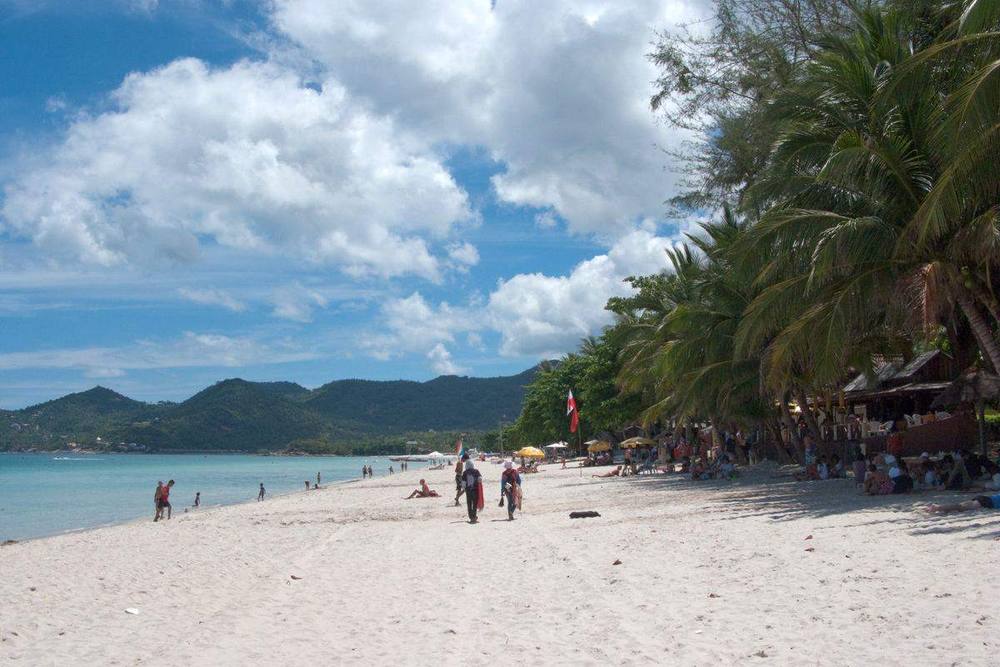
Every banknote a Samui money changer holds arrived by boat or plane, in a security vehicle, insured, and will go back the same way. The shop pays island rents and island wages. It competes with three other counters rather than thirty. And most of its customers have no realistic alternative, because walking to the next town is not a thing you do on Koh Phangan.
So the rate is worse. On Samui the gap against a competitive Bangkok counter is commonly a few per cent; on Phangan and Tao it is wider still. The counters themselves are generally small independents with a painted board and no website, which is why this site’s island pages publish the reference rate and a mainland benchmark rather than a ranking — there is nothing honest to rank.
The three islands, and what they are like
Koh Samui. The largest and best served. An airport with direct flights, proper banks, ATMs everywhere, hotels that take cards, and a reasonable number of exchange counters around Chaweng, Lamai and Nathon. Of the three, this is the one where you can change money without much friction, at a price. See the Koh Samui page.
Koh Phangan. Reached by boat from Samui or Surat Thani. Thong Sala has banks and ATMs; the beaches have fewer of both. During the full moon period everything is busier, cash runs short, and ATMs at the popular beaches empty out. See the Koh Phangan page.
Koh Tao. The smallest and the furthest out. Mae Haad has ATMs and a handful of places to change money. Infrastructure is thin and prices for everything reflect the cost of shipping it. Card acceptance is patchier than on Samui, and dive schools have their own payment habits worth checking in advance. See the Koh Tao page.
Koh Chang, on the eastern side of the gulf and reached from the Trat area, has the same economics with a mainland benchmark closer to Pattaya. See the Koh Chang page.
Why the ATM is not the escape hatch
The obvious reaction to a bad exchange rate is to use a machine instead. On an island that reasoning goes wrong in a specific way.
Thai ATMs charge foreign cards a flat 220 baht per withdrawal, on top of whatever your own bank adds. Flat means the percentage depends entirely on how much you take:
| Withdrawal | 220 baht as a % |
|---|---|
| 5,000 baht | 4.4% |
| 10,000 baht | 2.2% |
| 20,000 baht | 1.1% |
On an island, several things push you towards small, frequent withdrawals — machines that are out of cash, lower per-transaction limits on the machines at beach locations, and the general habit of topping up as you go. That is the expensive pattern. Four withdrawals of 5,000 cost 880 baht in fees; one of 20,000 costs 220. The rest of the arithmetic is in Thai ATM fees.
And the machine will offer, after you choose an amount, to bill you in your home currency. Decline it and take baht. That offer costs 3–8% and it is explained in dynamic currency conversion.
The plan that removes the problem
This is short, and it is the whole article.
Change your island money on the mainland, before you get on the boat.
Specifically:
- Work out roughly what the island week costs. Accommodation if you are paying cash, food, drinks, boat trips, dive courses, scooter rental, ferry tickets. Add a margin.
- Change that amount in Bangkok, where the spread is tightest — the Bangkok guide covers where — or in Surat Thani on the way through if you are going overland.
- Bring large, clean notes to change, and ask for a mix of 1,000s, 500s and 100s in baht. Small notes matter on islands, where a lot of transactions are 60 to 200 baht.
- Take one card as a backup, kept separately from your cash.
- If you do need to top up on the island, do it once and take a large amount, rather than five small withdrawals.
If you are flying directly into Samui without touching the mainland, change a modest amount at the airport, then change the rest at a counter in Chaweng or Nathon rather than at the terminal. Even on an island the arrival hall is the worst window.
Things that quietly cost more on islands
- Ferry and boat tickets bought through a hotel or an agent carry a margin over the pier price. Check the current pier price.
- Scooter rental deposits, often taken as a passport or a cash sum. Never leave a passport; offer a cash deposit or a copy.
- Dive courses, which are a significant amount of money and where the payment method changes the price at some schools. Ask before you book.
- Hotel exchange desks, which are the worst rate on the island by a distance.
- Full moon period on Phangan, when accommodation prices jump and cash gets scarce.
- Service charge. A resort restaurant adding 10% service and 7% VAT is charging you 17.7% over the menu price once the two compound, which catches people out — the mechanics are in hotel booking and the ++ problem.
Who does not need to bother with any of this
- Anyone on an all-inclusive resort stay. If your food, drinks and transfers are paid, you need pocket money for a boat trip and a few beers. Change a small amount wherever is convenient and enjoy yourself.
- Anyone going for two or three nights. The absolute difference on a small amount of cash is tens of baht, not thousands. It is not worth restructuring a trip around.
- Anyone staying on Samui in Chaweng, spending on a card. Samui’s card acceptance is good in hotels, restaurants and shops. If you are not a cash-heavy traveller, the island penalty barely touches you.
- Anyone who forgot and is already on the boat. You have not lost much. Take one large ATM withdrawal when you land, decline the home-currency offer, and get on with your holiday. The mistake to avoid now is five small withdrawals, not the one big one.
The people who should genuinely plan ahead are those staying a week or more, paying for accommodation or a dive course in cash, or heading to Phangan or Tao rather than Samui. For them the difference between changing on the mainland and changing at the beach is real money — and the fix costs nothing except remembering to do it before the ferry leaves.