Where cash is still the only option in Thailand
Article updated: 2026-09-17
Best rate USD · Bangkok: 33.24 — Superrich Thailand — Headquarter Rajdamri 1 · Sep 20, 08:58 → Details
Thailand gives a confusing first impression on payments. A Bangkok shopping mall is as card-friendly as anywhere in the world. Fifty metres outside it, the entire economy runs on notes. Neither picture is wrong, and the split between them is predictable enough to plan around.
This is the list of situations where a card will not help you, and what to carry because of it.
Transport
Taxis. Metered taxis are a cash business. Some drivers take a QR payment from Thai customers, almost none take a foreign card, and a driver who agrees to a card at the start of the ride is usually arranging something you will not like at the end of it. Ride-hailing apps are the exception — if you pay in the app with a card, that is a card transaction and works normally.
Motorbike taxis, songthaews, tuk-tuks. Cash, in small notes. A songthaew fare is a coin-and-small-note transaction and handing over a 1,000-baht note will simply stop the journey.
Local buses and boats. Cash, and again small. The Chao Phraya boats, the canal boats and city buses all have a conductor with a coin tube.
Intercity buses and minivans bought at the station. Counter purchases are usually cash. The same seat bought online in advanceAd is usually a card transaction.
The BTS, MRT and Airport Rail Link take cards at the machines in many stations now, and stored-value cards can be topped up by card at counters, but do not rely on it at a small station late in the evening. Airport transport costs are broken down in getting from the airport to the city.
Food and markets
Street food. Cash, without exception for a visitor.
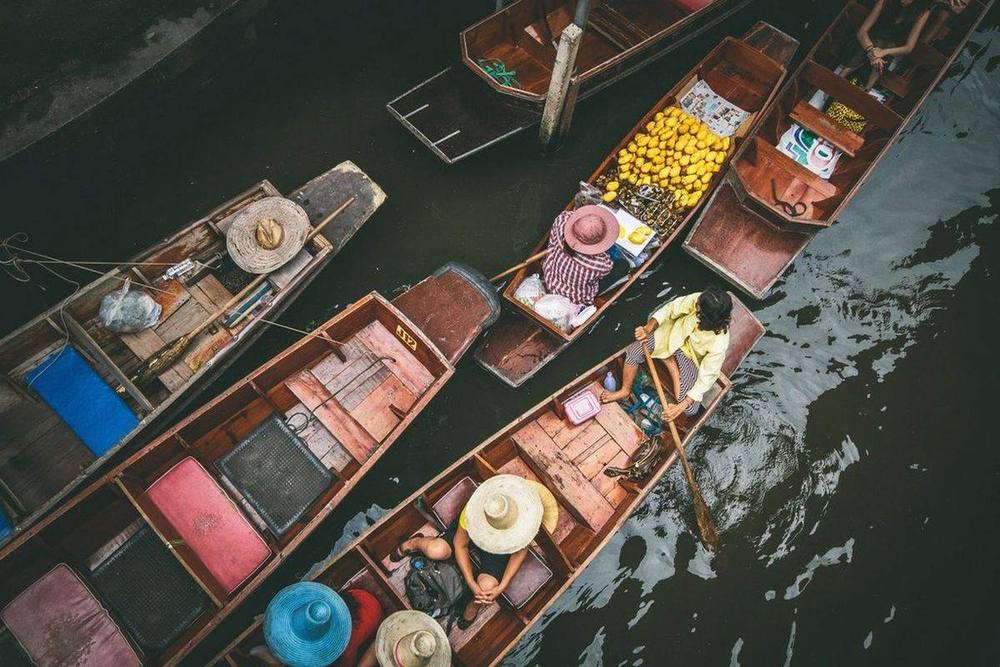
Markets. Chatuchak, the night markets, floating markets, fresh markets — cash. Some larger stalls display a QR, which does not help most visitors.
Small local restaurants. The rule of thumb is that if there is no printed menu in English and no air conditioning, bring cash. Shophouse restaurants, noodle shops and food courts in older malls are cash or a stored-value card bought at the entrance.
Food courts deserve their own line because they surprise people: many run a closed-loop card you buy and load at a booth, refunding the balance when you leave. That loading step is frequently cash.
Accommodation and services
Guesthouses and small hotels. Many take card for the booking and cash for everything on site. Some take cash only, which is usually visible on the booking page if you read the payment conditions.
Deposits. A rental deposit, a scooter deposit, a monthly rent payment — cash, or a Thai bank transfer you cannot make. This is covered in renting by the month.
Laundry, barbers, small massage shops, tailors’ deposits. Cash.
Tips. A service charge on a bill can go on the card. A note left on the table cannot. See tipping and service charges.
Attractions, temples and rural Thailand
Temple donations and entry boxes. Cash, in small notes.
Smaller attractions and national parks. Many have a cash-only window, and some have a foreigner price that differs from the Thai price. The larger sites in Bangkok take cards — the Grand Palace’s 500-baht ticket among them — and the online-versus-window question is covered in Bangkok attraction tickets.
Small towns and islands. The further from a city you go, the more the card becomes decoration. On the smaller islands, a cash-only day is normal and the nearest machine may be a boat ride away. See the island rate penalty.
The surcharge that makes cash cheaper
There is a second category: places that accept a card but charge you for using it. A 3% card surcharge is common at small businesses, some guesthouses and many tour desks. It is legal, it is usually stated on a small sign, and it makes cash the cheaper choice for that transaction. If you are handing over a card for something in the low thousands of baht, ask whether there is a card fee before you do.
So how much cash should you carry?
Think in two layers rather than one number.
A daily float for transport, food, markets and small purchases. For most travellers that is a few hundred to about a thousand baht in your pocket, mostly in 20s, 50s and 100s. Break large notes at convenience stores and supermarkets early in the day, because the small ones are what you actually need.
A reserve kept at the hotel or in a separate pocket, sized to the things you know are cash-only this week: a deposit, a tour paid on the day, a boat ticket, a few nights at a guesthouse.
Get both from a counter rather than a machine where you can. Each ATM withdrawal costs a flat 220 baht plus whatever your own bank adds, while a competitive city counter sits within roughly 1% of the mid-market rate. The arithmetic is in Thai ATM fees, and today’s ranking is on the Bangkok rates page and in the shop list.
When not to bother carrying much
Some trips genuinely do not need a thick wallet.
- A short city stay in a business hotel. Breakfast, meetings, mall restaurants and ride-hailing apps are all card transactions. A few hundred baht for incidentals covers it.
- A resort package with meals included. The bill goes on the room and the room goes on the card. Carry enough for tips and a trip into town.
- You are worried about theft and staying somewhere with plenty of machines. Carrying less and withdrawing more often costs you 220 baht a time. That is a reasonable price to pay for peace of mind, and there is no need to feel you have failed a test by paying it.
The mistake to avoid is the opposite one: arriving with a card and no notes, then discovering that the thing you want at nine in the evening — a taxi, a bowl of noodles, a boat, a deposit — is one of the things that has never taken a card and never will.