Island-hopping costs: ferries, boats and what is worth pre-booking
Article updated: 2026-09-17
Best rate USD · Phuket: 33.13 — Mamy Exchange (Koh Kaew) · Sep 20, 08:58 → Details
Island transport in Thailand looks chaotic from the outside and is actually quite orderly, once you see that there are only four products being sold and that they are aimed at different people. Most of the money travellers lose here comes from buying the wrong one, not from being overcharged for the right one.
The four products
The scheduled ferry. A large vehicle or passenger boat running a fixed timetable between a mainland pier and an island. Slow, stable, cheap per person, and the one that keeps running in weather that stops the small boats. This is the backbone of the Samui and Phuket-area routes and the one to default to.
The speedboat. Faster, several times the price, and much more affected by sea conditions. Worth it when it saves you a connection or a night, unpleasant in swell, and genuinely rough on the Gulf routes in the monsoon.
The joined-up ticket. A single booking covering bus or minivan plus ferry, sometimes plus a transfer at the other end. This is what most people actually buy for a journey like Bangkok to Koh Tao or Phuket to Koh Phi Phi. The convenience is real: one operator is responsible for making the connection, and if the bus is late the boat is theirs too.
The day-trip tour. A different product entirely — a boat, a guide, snorkelling stops, lunch, and national park fees. Do not compare its price to a ferry ticket; you are not buying transport.
What is worth pre-booking
The honest answer is: less than the booking sites imply, and more than the “just turn up” crowd claims. The distinction is about consequence rather than price.
Book ahead when:
- You are travelling on a fixed date with a flight afterwards. A missed connection costs more than any ticket.
- It is high season — roughly December through March on both coasts, plus Songkran and the Chinese New Year week. Boats fill.
- You want a specific departure time, particularly the first or last of the day.
- You are buying a joined-up ticketAd across a long distance. The whole value is the connection, and that has to be arranged in advance to exist.
- You are moving a group, or you have a lot of luggage.
Do not bother booking ahead when:
- It is low season and the route is a busy one. Several daily departures with empty seats means the pier counter will serve you.
- Your plans are loose. Island travel plans change constantly, and a non-refundable dated ticket is exactly the wrong purchase for a flexible trip.
- It is a short, frequent hop — the kind of route with a boat every hour.
- It is a day trip. These can almost always be booked the previous evening at your accommodation, often at a better price than online, and you can look at the sea before committing.
What actually costs money on an island trip
The transfers at each end. A ferry ticket gets you pier to pier. Getting to the mainland pier and from the island pier to your accommodation is separate, frequently by songthaew or taxi at island prices, and it can add a substantial fraction to the journey cost. Check whether a quoted fare includes transfers before comparing two of them.
National park fees. Many of the best snorkelling and beach destinations sit inside national parks, which charge an entry fee per person — usually higher for foreigners than for Thai nationals — and this is often not in the tour price. Ask specifically.
The return leg. A one-way price shown cheaply online sometimes assumes a return booking. Price the round trip.
Luggage. Some speedboat operators limit or charge for large bags. Rarely a disaster, occasionally a surprise.
Weather. Cancellation for sea conditions is a normal part of island travel, particularly on the Gulf side in the late-year monsoon and on the Andaman side in the mid-year one. Operators usually rebook you rather than refund. Build a spare day before any flight you cannot miss.
Actual fares vary by operator, season and route and change frequently, so check the current price with the operator or the pier counter rather than relying on a figure from an article. What is stable is the ranking: ferry cheaper than speedboat, joined-up ticket priced at a premium for the connection, day trip in a category of its own.
The money problem nobody warns you about
Islands are where Thailand’s exchange rates are at their worst and its machines at their scarcest. A single shop with a painted board and no competition for several kilometres prices accordingly, and the flat 220-baht ATM fee bites hardest where you are withdrawing small amounts because the machine limit is low or the machine is empty.
The fix is entirely in your hands and has to be done before you get on the boat: change enough money on the mainland. Work out the days, the accommodation, the boats, the food and a margin, and change it in Surat Thani, Phuket town, Bangkok or wherever you are leaving from. The arithmetic behind this is in the island rate penalty, and the machine side in Thai ATM fees.
Carry small notes as well as large. Pier snacks, songthaews, beach bars and long-tail boats are cash and often cannot break a 1,000-baht note.
Island reference pages, with the mainland benchmark to judge the local board against: Koh Samui, Koh Phangan, Koh Tao and Koh Chang, with the full list on the islands page.
Long-tail boats and private charters
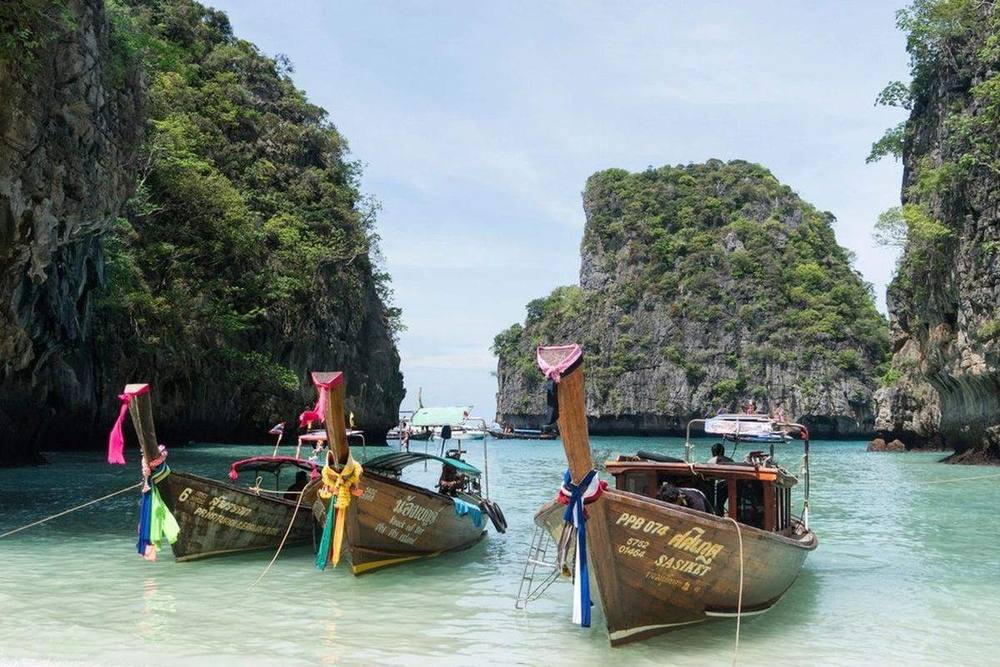
Hiring a long-tail for a half day to reach a beach with no road is one of the better things you can do in Thailand, and it is a negotiation rather than a tariff. Agree the price, the number of stops, the duration and whether it is per boat or per person before you step in, and pay at the end. A boat hired for a group splits well; hired alone it is expensive.
When not to bother island-hopping at all
Reconsider the plan if any of this is you.
- You have under a week in the country. Two islands in five days is mostly boats and piers. Pick one.
- You get seasick. The Gulf crossings are long and the speedboats are worse than the ferries. A single island reached by a short hop is a better trip than three reached by four hours of open water.
- You are travelling in the wrong monsoon for that coast. Thailand has two coasts with opposite seasons, and going to the wrong one in the wrong month buys you cancelled boats and grey beaches.
- You have a tight flight home. Island transport is reliable on average and unreliable on any given day. Do not let a boat be the only thing between you and an international departure.
The best island trips tend to be the least ambitious ones: one crossing out, several days in one place, one crossing back, and all the money changed before you left the mainland.