Ayutthaya, Nakhon Pathom and Ratchaburi: day-trip towns and their booths
Article updated: 2026-09-17
Best rate USD · Ayutthaya: 33.15 — Twelve Victory — Lotus Ayutthaya City Park · Sep 20, 08:58 → Details
The ring of towns around Bangkok — Ayutthaya to the north, Nakhon Pathom and Ratchaburi to the west, Chai Nat further up the river — are day-trip territory. Most people who go there leave Bangkok after breakfast and are back by evening.
That single fact decides the money question for almost everyone, and it is worth stating up front: change your money in Bangkok and take it with you. The rest of this article is about the cases where that is not enough, and what to expect if you stay the night.
Ayutthaya
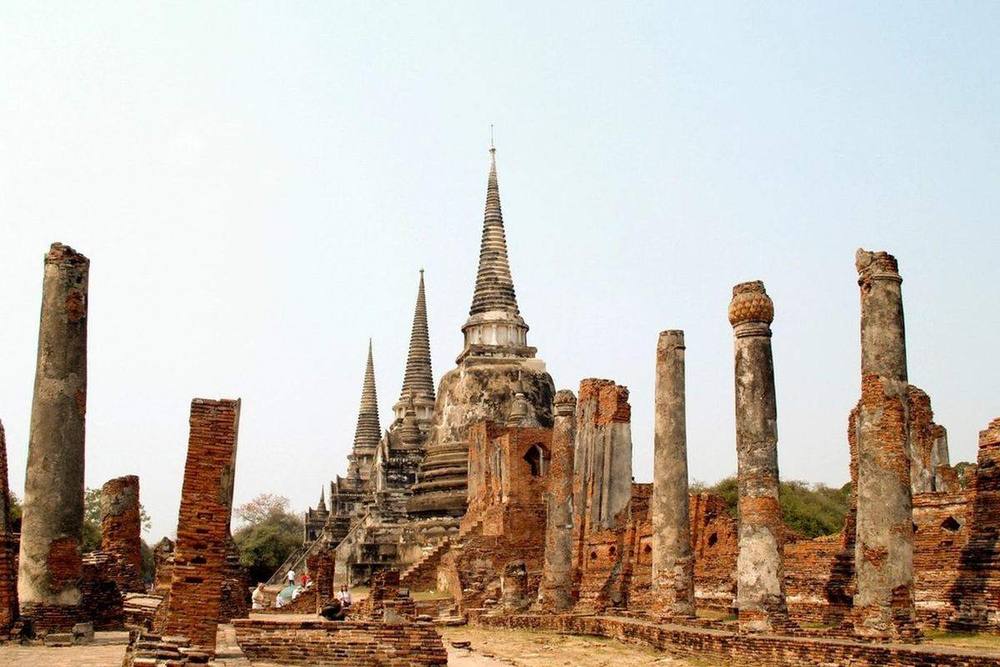
The old capital, an hour or so north by train, minivan or car, and the busiest day trip from Bangkok after the Grand Palace itself.
Ayutthaya has exchange counters — Twelve Victory Exchange operates in the town — along with bank branches and ATMs around the town centre and the station. Live boards and hours are on the Ayutthaya page.
What you actually need money for is small and cash-shaped: temple entry fees at each of the main ruins, a bicycle or a tuk-tuk for the day, lunch, water, and the boat if you take one. All modest amounts and all easier with 100- and 20-baht notes than with a 1,000.
Expect counter rates 1–3% behind a competitive Bangkok shop, and provincial hours — generally closing between 17:00 and 18:00. If you arrive on the afternoon train with no baht, you have a narrow window.
Nakhon Pathom and Salaya
West of Bangkok, home to the enormous Phra Pathom Chedi and, at Salaya, a large university campus. This is a Thai town that receives foreign visitors rather than a tourist town, and the exchange presence reflects that — Twelve Victory Exchange is present, alongside banks. Boards on the Nakhon Pathom page.
Most foreign visitors pass through Nakhon Pathom on the way to the floating markets or Kanchanaburi rather than stopping. If that is you, the money you need is for entry, lunch and transport, and you should have it before you set off.
Ratchaburi
Further west, and the province containing Damnoen Saduak — the floating market that appears on every Thailand itinerary — as well as the Maeklong railway market nearby in Samut Songkhram.
Ratchaburi town has a counter presence, again including Twelve Victory Exchange, plus banks. The Ratchaburi page has what is published.
The floating market itself deserves a warning that is about spending rather than exchanging. It is a cash environment, prices are negotiable, boat hire is negotiated before you get in, and the rate you will be offered if you try to pay in foreign currency anywhere there is not worth considering. Arrive with baht in small notes.
Chai Nat
Further up the Chao Phraya, well beyond comfortable day-trip range and firmly a Thai provincial town. Twelve Victory Exchange operates here. If you are this far up the river you are travelling independently and already know to carry cash. The Chai Nat page has the boards.
Why changing in Bangkok wins
The arithmetic is simple enough to do in a sentence. On a typical day trip you might spend the equivalent of thirty to eighty dollars. A provincial counter being two per cent behind Bangkok costs you well under a hundred baht on that amount — less than the tuk-tuk you will take from the station.
So the reason to change in Bangkok is not the rate. It is the three practical things:
Hours. Bangkok counters run late. Provincial ones close in the late afternoon, which is exactly when you will be walking around a temple complex rather than looking for a shop.
Certainty. You know Bangkok has a counter within walking distance of wherever you are staying. You do not know, on a Sunday in a town you have never visited, that the one near the station is open.
Denominations. Bangkok counters hand you a sensible mix on request. Entry fees, songthaews and market stalls all want small notes, and breaking a 1,000-baht note repeatedly in a small town is tedious for you and for everyone serving you.
The Bangkok money changer guide covers where to do it before you leave.
If you do need cash out there
Every one of these towns has bank ATMs. The flat 220-baht fee applies to foreign cards, so one withdrawal of 10,000 or 20,000 baht is far better than several of 5,000 — 2.2% and 1.1% against 4.4%. Full arithmetic in Thai ATM fees. Decline the machine’s offer to bill you in your home currency, every time.
If you use a counter, bring your passport. Licensed changers are required to record identification regardless of the amount, and a small-town counter is no more flexible about it than a Bangkok one — see passport and ID rules.
Bring large, clean notes to change, and expect condition tolerance to be lower than in the city. Where a shop has fewer buyers for the foreign cash it takes, it is fussier about which notes it accepts, as set out in banknotes a Thai booth will refuse.
Budgeting a day trip
Entry fees at these sites are set by the authorities and are not negotiable. For scale, the Grand Palace in Bangkok is 500 baht; provincial historical parks are considerably less. Check the current price for each site rather than relying on a figure from a blog, because they do change.
The rest of the day is transport, food and a guide if you want one. What is genuinely worth pre-booking is a car or a guided day tour with several stopsAd — Damnoen Saduak plus Maeklong plus something else in one day is a real logistical exercise, and negotiating it in pieces at 07:00 is how people end up paying for the same journey twice. Whether the guided version is worth it depends on how much you mind organising things. Related reading: Bangkok attraction tickets.
Who does not need this article
- Anyone doing a day trip and returning to Bangkok. Change money in Bangkok, take small notes, and never look at a provincial counter. That is the entire answer.
- Anyone on an organised tour with entry and lunch included. You need pocket money and nothing else.
- Anyone going to Ayutthaya by train for an afternoon. The train fare is trivial, the entry fees are modest, and a few hundred baht in your pocket covers the day.
- Anyone paying by card at the hotel and eating at places that take cards. In Ayutthaya that works for the larger restaurants; at the ruins and the markets it does not.
The cases where the local counters matter are the ones where you are staying several nights — Ayutthaya has a real guesthouse scene and people do spend a week there — or travelling on rather than back. For everyone else, this ring of towns is a cash-in-your-pocket exercise, decided before you leave the city.