Leftover baht: buy-back rates, spending it, or keeping it before you fly home
Article updated: 2026-10-15
Best rate USD · Bangkok: 33.50 — Superrich Thailand — Headquarter Rajdamri 1 · Nov 8, 05:52 → Details
Changing money back at the end of a trip is where the second half of the spread gets collected. It is worth five minutes of planning, and as of 15 October 2026 the numbers show that where you do it matters far more than whether you do it.
Why the return trip costs more than you think
When you arrived, you used the Buying column. Going home you use Selling: you are buying foreign currency from the shop with baht.
Both directions carry a margin, and you pay both. At a competitive counter the round trip is small. On 15 October the best Bangkok counter was buying US dollars at 33.51 and the lowest selling rate on the tracked boards was 33.55, a round trip of 0.04 baht, about 0.1%, or 40 baht on US$1,000. Euros were 37.50 against 37.65 (0.15 baht, 0.4%) and pounds 44.40 against 44.55 (0.15 baht, 0.3%). Yen were 0.2115 against 0.2130, which is 150 baht on 100,000 yen, about 0.7%.
Those are the best numbers in the country. Pick a weaker counter and the round trip widens quickly: the lowest dollar buying rate in Bangkok that day was 33.15, so a traveller who changed in at the worst board and out at the best still paid 0.40 baht, over 1%.
The airport is the worst place to do it
Same as on arrival: departure-hall counters have the widest spreads in the country. They do not publish their rates, so the site cannot give you a figure, and that is precisely the problem; you will only learn the number at the window, with a flight to catch. If you must change at the airport, expect to lose meaningfully more than in the city. The two tracked counters at Suvarnabhumi are on the Airport Rail Link level, not in the departure hall, and the Happy Rich desk there is open 05:00 to 24:00, which makes it the practical option for anyone leaving by train with baht to sell.
Four better options
1. Spend down deliberately. Put the last hotel bill, the final dinner and any souvenirs on a card, and use cash for everything until it runs out. This costs you nothing.
2. Change it in the city, not the airport. If you have a real amount left, say over 10,000 baht, a city shop will give you a far better selling rate than the terminal. Compare the selling column: the shop with the best buying rate is not always the one with the best selling rate, and the ranking flips between the two directions.
3. Keep it for next time. If you visit Thailand more than about once a year, holding the notes costs you nothing and saves the round-trip spread entirely. Banknotes do not expire.
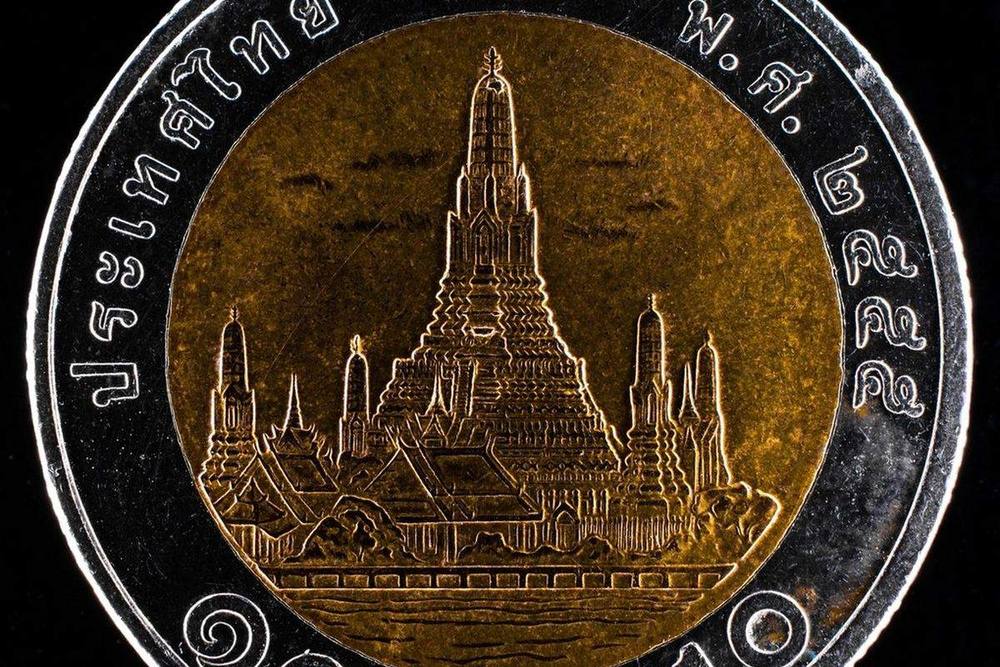
4. Donate the coins. Thai coins cannot be exchanged anywhere outside Thailand, and most shops will not take them either. Donation boxes at the airport and at temples are the practical answer.
City by city, as of 15 October 2026
| City | Best dollar buying rate | Lowest dollar selling rate | Round trip |
|---|---|---|---|
| Bangkok | 33.51 | 33.55 | 0.04 |
| Pattaya | 33.43 | 33.60 | 0.17 |
| Phuket | 33.41 | 33.54 | 0.13 |
| Chiang Mai | 33.48 | 33.55 | 0.07 |
| Hua Hin | 33.50 | 33.55 | 0.05 |
Bangkok’s 86 counters produce the tightest round trip. Pattaya’s 62 counters are strong on the buying side but a little wider on the way out, 0.17 baht or about 0.5% on dollars, and wider still on euros (37.30 buying against 37.65 selling, about 0.9%). Chiang Mai and Hua Hin, with two and four tracked counters respectively, are within a few hundredths of Bangkok. In every city the round trip at a published-rate counter is a fraction of what people fear; it is the untracked departure-hall booth that costs real money.
Pattaya has one further advantage for a late departure: several T.T. Currency Exchange branches, including Central Pattaya and Terminal 21, are open until 22:00, and the Central branch until 23:00, so the change-back can be done the evening before an early transfer to Suvarnabhumi.
Timing: head offices close early
The counter that set Bangkok’s best buying rate on 15 October, Superrich Thailand’s head office on Rajdamri 1, closes at 18:00 on weekdays, 17:00 on Saturday and does not open on Sunday. If your flight leaves on a Sunday night, plan the change-back for Saturday afternoon, or use one of the later counters: Value Plus on Soi Thaniya in Silom is open 12:00 to 23:00, and the Happy Rich counter at the Suvarnabhumi rail-link station until midnight. Five of the 63 Bangkok counters with known hours are closed on Sunday; the other 58 are open. Sunday and holiday money changers lists them, and departure-day money walks through the last day in order.
If you are changing back, check the selling column
On the city pages, switch the widget to “buy foreign currency with baht” and the ranking flips to show the lowest selling rates first. That is the number that matters when you are going home, and it is a different ranking from the arrival one. Buying foreign cash in Thailand explains what the selling side looks like for the currencies people most often need on the way out.
A note on large amounts
There is no practical limit on taking foreign currency out of Thailand for ordinary travellers, but carrying a large amount of cash through an airport is simply a risk. Spending down, or converting in the city and splitting it between bags, is safer than doing it all at the gate. For a sum in the tens of thousands of baht, a head office branch is more likely to hold the foreign notes you want than a mall kiosk, and you will need your passport in either case under the ID rules.
Before you exchange:Aviasales ↗AirHelp ↗Trip.com ↗