Chiang Rai and the northern border: Mae Sai, the Golden Triangle and Chiang Khong
Article updated: 2026-09-17
Best rate USD · Chiang Rai: 33.18 — Super Money — Chiang Rai (Prasopsuk Road) · Sep 20, 08:58 → Details
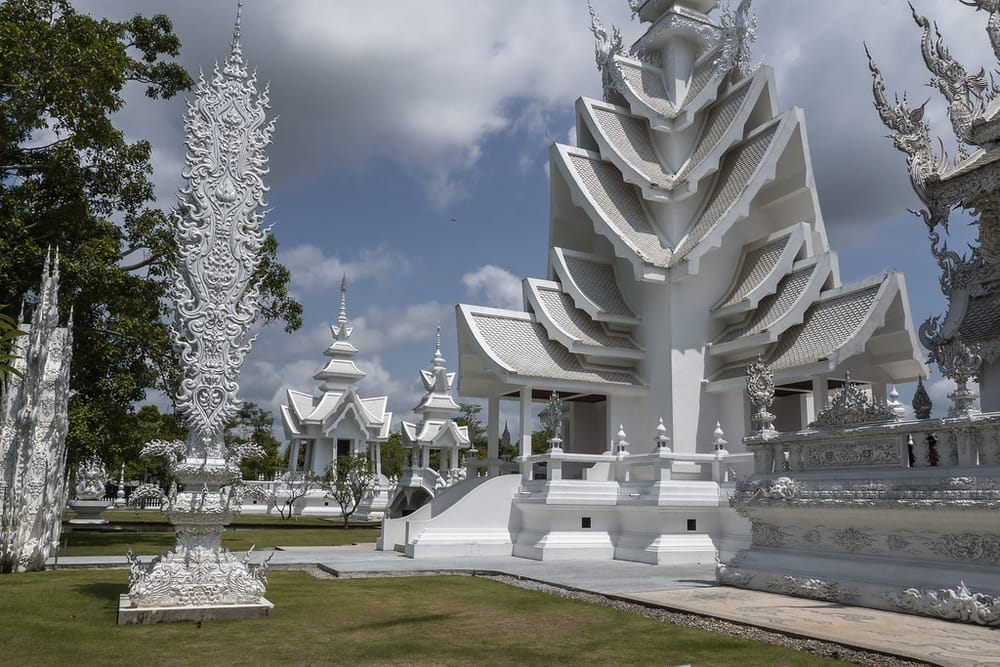
Chiang Rai province occupies Thailand’s northern tip, wedged between Myanmar and Laos. Visitors come for the white temple, the mountains, the tea country around Mae Salong, and the two border points — Mae Sai opposite Tachileik in Myanmar, and the Golden Triangle where the Mekong divides three countries.
It is a rewarding part of the country and a poor one for changing money. That is not a complaint about the shops; it is arithmetic. Fewer foreign visitors means fewer counters, means less competition, means a wider spread.
Chiang Rai town
The town is small. Counters cluster near the clock tower, the night bazaar and the bus station, which is the pattern in most provincial Thai towns: exchange follows tourists and tourists follow the market.
Of the tracked chains, Twelve Victory Exchange and Super Money Chiangmai both operate in the province. Bank branches also change money, and in a town this size a bank is a reasonable fallback in a way it is not in Bangkok — though a dedicated counter will usually still beat it.
Expect rates roughly 1–3% behind a competitive Bangkok counter for US dollars and euros, and wider for anything less common. That is the normal provincial penalty and it applies across the north.
Hours are the bigger constraint. Provincial counters generally close between 17:00 and 18:00, considerably earlier than Bangkok’s 20:00 or 21:00, and some do not open on Sundays. Landing in Chiang Rai on a Sunday evening with no baht is a genuinely awkward position. Current opening hours for the shops we track are on the Chiang Rai page.
Mae Sai
Mae Sai is the northernmost point in Thailand, an hour or so north of Chiang Rai town by road, and the crossing to Tachileik. The town is a market town first and a tourist destination second — much of the traffic across that bridge is trade, not holidays.
What that means for money:
- US dollars are the usable currency. Dollars are understood everywhere along this border and are what cross-border trade runs on.
- Myanmar kyat is traded here and essentially nowhere else in Thailand apart from Mae Sot. If you need kyat, this is the place; if you come back with kyat, this is also where you will have to sell it, because a Bangkok counter is unlikely to want it.
- Euros are handled, at a wider spread than in the city.
- Yen, won, roubles and minor European currencies may not be handled at all. Change those before you come north.
- Hours are short and Sunday closures are common.
Border conditions at this crossing change, sometimes at short notice, and a day trip into Tachileik is not something to assume is available. Check the current situation locally before planning around it.
The border town guide covers the same ground for Nong Khai, Mukdahan, Nakhon Phanom and Mae Sot.
The Golden Triangle and Chiang Saen
Sop Ruak, the point where Thailand, Laos and Myanmar meet on the Mekong, is a viewpoint and a cluster of souvenir stalls rather than a town. There is no realistic exchange infrastructure there. Chiang Saen, a few kilometres downstream, is a small town with a bank or two and not much else.
Treat both as places you arrive at with baht already in your pocket. Boat trips, entry fees and lunch are all cash transactions in baht.
Chiang Khong
The crossing to Huay Xai in Laos, and the start of the slow boat down the Mekong to Luang Prabang. Travellers heading that way have a specific problem: the boat takes two days and there is very little on the way.
If that is your route, change enough baht in Chiang Rai or Chiang Mai to cover the crossing, the visa fee at the Lao border if one applies to your nationality, the boat, and two days of food, and check the current cost of each. Lao kip is traded at Nong Khai and along the Mekong crossings, but do not count on finding it in Chiang Rai town.
The practical plan for the north
- Change your main amount in Chiang Mai, where the counters are better and there is real competition. The Chiang Mai guide covers where they are.
- Bring large, clean notes. Small denominations are penalised harder where competition is thin, and condition tolerance is lower — see banknotes a Thai booth will refuse.
- Carry your passport. Licensed changers must record identification, and you need it at the border regardless.
- Arrive in Chiang Rai with enough baht for a day. Assume you may land after the counters close.
- Keep a card as backup. Bank ATMs exist in Chiang Rai, Mae Sai and Chiang Khong. The flat 220-baht fee applies, so one withdrawal of 20,000 costs 1.1% while four withdrawals of 5,000 cost 4.4%. The full arithmetic is in Thai ATM fees.
- Do not plan on changing money on the far side of a border immediately. Hours, availability and the currencies on offer vary.
Getting there
Chiang Rai has its own airport with domestic flights from BangkokAd, and buses run from Chiang Mai in roughly three hours. What is published inside the terminal is on the Chiang Rai airport page; as at most small Thai airports, do not expect a competitive rate there.
Within the province, transport is songthaews, local buses and rented motorbikes or cars. Distances are real — Mae Sai and Chiang Khong are each a substantial drive from the town — which is another argument for carrying enough cash rather than planning to top up along the way.
Who does not need to do any of this
- Anyone visiting Chiang Rai for two days as a side trip from Chiang Mai. Change what you need in Chiang Mai, bring it with you, and do not think about exchange counters at all.
- Anyone on an organised tour. If the white temple, the Golden Triangle and lunch are all included, you need pocket money and nothing more.
- Anyone spending on a card. Hotels and the larger restaurants take cards. Your costs are your issuer’s foreign transaction fee and the 220-baht ATM charge, not the local spread.
- Anyone changing a small amount. On the equivalent of a hundred dollars, the provincial penalty is a few tens of baht. Use the nearest counter and get on with your day.
The people this matters to are the ones going to Mae Sai or Chiang Khong to cross, carrying enough money for a week, and doing it on a Sunday — because that is where the short hours, the thin currency coverage and the wider spread all land at once.