Bangkok's big temples: entry fees, audio guides and the two classic traps
Article updated: 2026-09-21
Best rate USD · Bangkok: 33.24 — Superrich Thailand — Headquarter Rajdamri 1 · Sep 20, 08:58 → Details
The three temples that every first visit to Bangkok includes sit within a kilometre of each other on the river, and a day spent on them costs about a thousand baht at the gates. That is cheap. The money that goes astray on the temple day goes on the things around the gates: the guide who is not a guide, the tuk-tuk that is going somewhere else, and the audio guide you did not need to rent because you already had one in your pocket.
What the gates charge
| Temple | Rough entry | Hours | Notes |
|---|---|---|---|
| Grand Palace and Wat Phra Kaew | 500 baht | Roughly 8:30–15:30 | Last entry before closing; strictest dress code |
| Wat Pho | 300 baht | Daylight hours | Includes a bottle of water; reclining Buddha and the massage school |
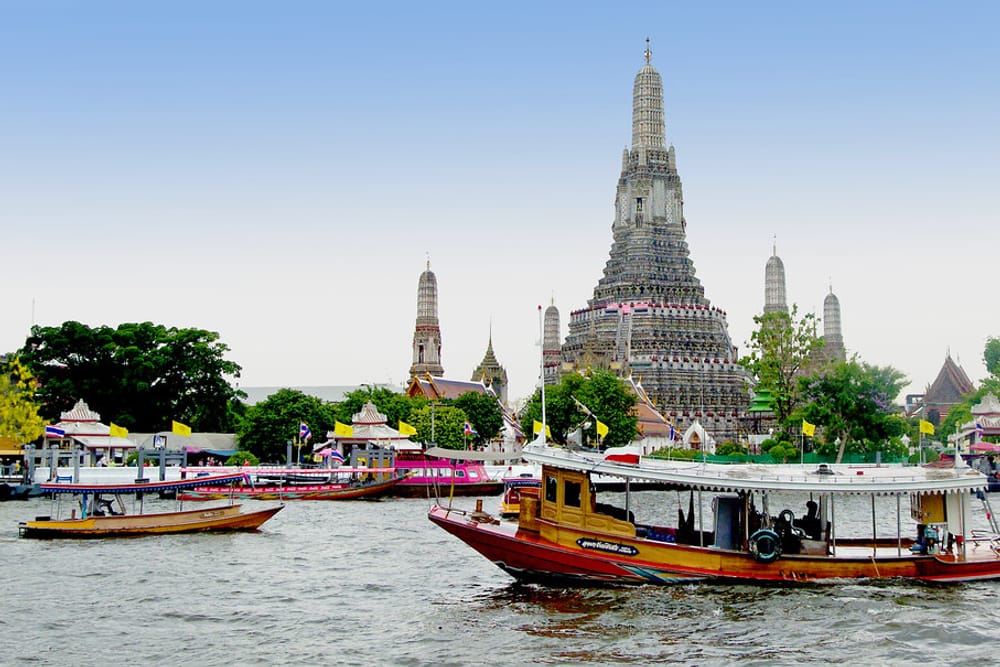
| Wat Arun | 200 baht | Daylight hours | Across the river; ferry for a few baht |
All figures are approximate and drift upward every couple of years; check the board at the gate. Cash is safest for the small entries, and the big ticket offices at the Grand Palace and Wat Pho accept cards.
Two things about the Grand Palace hours matter. It closes to visitors in the middle of the afternoon, earlier than most people expect, and the last entry is before that. Go in the morning, when it is also cooler and the light on the gold is better. It is occasionally closed for royal ceremonies, and when it is, a sign at the gate says so — not a stranger on the pavement.
The audio guide question
At the Grand Palace you can rent an audio guide for roughly 200 baht, leaving a passport or a card as a deposit. It is a reasonable product: the palace is dense with iconography that means nothing without explanation.
The alternative is a self-guided audio tour on your own phone, bought online for a few dollars or euros, that covers several temples with a map and works offline once downloaded. For a whole day on the river this beats the rental on every count: it costs about the same as one rental and covers three sites, there is no deposit and no queue to return the handset, and it keeps working on the ferry between temples. Download it the night before over hotel Wi-Fi and bring earphones.
A licensed guide at the gate — the ones with an official badge — will quote roughly 1,000–2,000 baht for a couple of hours. For a group of four that is competitive with the audio options; for a couple it is the expensive choice, though a good one. Agree the price and the duration before you start, and only with someone wearing the badge.
Getting between them
The three temples line up along the river, and the Chao Phraya express boat is both the cheapest and the most pleasant way to move between them. From the pier at Tha Tien, by Wat Pho, a cross-river shuttle ferry takes you to Wat Arun for a few baht, and the express boat runs north and south along the whole tourist stretch for not much more. Fares are paid in cash on board or at the pier; keep small notes.
A tuk-tuk for the same hops costs several times as much. That is not the trap, though; the trap is the tuk-tuk that offers to take you somewhere else.
The two traps
“The temple is closed today.” Near the Grand Palace, a friendly, well-dressed stranger — sometimes claiming to be a teacher or a government worker — explains that the palace is closed this morning for a ceremony, and helpfully suggests another temple, with a tuk-tuk to take you there for almost nothing. The temple may exist, but the route runs through a gem shop, a tailor, or a travel agency, where the driver is paid for delivering you and you are pressed to buy. The palace is not closed. Walk to the gate; if it is closed, you will see a sign.
The gem-shop detour. The same mechanism without the closed-temple story: a cheap tuk-tuk ride that includes an unrequested stop at a shop selling “export-quality” gems at a “government promotion” price. There is no promotion and there is no export scheme. Anything you buy there is worth a fraction of the price, and there is no refund. Any driver who suggests a stop you did not ask for should be paid and left.
Neither trap is dangerous. Both work on people who want to be polite. The defence is to know the palace is open and to decline the ride.
Dress code
The Grand Palace enforces it at the gate: no shorts, no bare shoulders, no torn jeans, no see-through fabric, and shoes rather than flip-flops are preferred. Wat Pho and Wat Arun apply the same rules with a little less rigour. Sarongs and cover-ups are sold outside every gate for a small sum, and there is a rental counter at the palace, but the simplest thing is to dress for it in the morning: light trousers or a long skirt, a shirt with sleeves.
A day on the river, costed
- Grand Palace, morning: about 500 baht, plus 200 for the rental audio guide or nothing if you brought your own.
- Walk to Wat Pho: about 300 baht, water included.
- Ferry to Wat Arun: a few baht each way, then about 200 baht at the gate.
- Express boat back along the river to a BTS pier: a modest cash fare.
Roughly 1,000–1,200 baht per person for the three temples and the boats, and a few dollars for a phone audio tour that covers all of them. The pass question — whether a multi-attraction pass covers any of this — is answered in Bangkok pass versus single tickets: it mostly does not, and for a temple day it does not need to.