Delays and cancellations out of Bangkok: what you can actually claim
Article updated: 2026-09-17
Best rate USD · Bangkok: 33.24 — Superrich Thailand — Headquarter Rajdamri 1 · Sep 20, 08:58 → Details
There is a lot of confident advice online telling delayed passengers they are owed a fixed cash sum. Most of it is written about European departures and quietly assumes the reader is at a European airport. If you are standing at Suvarnabhumi looking at a five-hour delay, the first thing to establish is whether any of it applies to you, because usually it does not.
This page is about getting that answer right rather than raising your hopes.
The EU rule, stated precisely
EC 261 applies in exactly two situations:
- Your flight departs from an airport in the EU or EEA — on any airline, European or not.
- Your flight arrives in the EU from outside it, operated by an EU-based carrier.
Apply that to a departure from Bangkok and the result is narrow but clear.
- Bangkok to an EU airport on an EU airline — covered. This is the case that catches a lot of European travellers by pleasant surprise.
- Bangkok to an EU airport on a Thai, Gulf, Asian or any other non-EU airline — not covered. Same route, same disruption, no EC 261 claim.
- Bangkok to Tokyo, Sydney, Singapore, Dubai, Seoul, anywhere outside the EU — not covered at all, on any airline. The rule has nothing to say about it.
- Bangkok to London falls under the UK’s own near-identical scheme on the same logic: a UK carrier arriving in the UK is inside it, another airline flying the same route is not.
The direction matters as much as the airline. The identical aircraft flying Frankfurt to Bangkok is covered because it departed an EU airport; flying Bangkok to Frankfurt it is covered only if the operator is an EU carrier.
Connections. Where a single booking runs Bangkok to a European city with a change somewhere, the relevant questions are the operating carrier of each leg and the departure airport of each leg. A through booking on an EU carrier reaching an EU destination is generally inside the rule. A through booking on a non-EU carrier is not, even if the final destination is in Europe.
What EC 261 pays, where it applies
Where it does apply, and the disruption is the airline’s responsibility rather than an extraordinary circumstance such as weather, air traffic control action or a security incident, the compensation is a fixed cash amount:
- 250 euros for short flights
- 400 euros for medium
- 600 euros for long-haul over 3,500 km — which is what any Europe–Bangkok flight is
It is triggered by arriving three or more hours late, by a cancellation announced with less than fourteen days’ notice, or by denied boarding. It is a fixed sum regardless of what the ticket cost, and it is separate from any refund.
What you get when EC 261 does not apply
This is the more useful half of the page for most readers at a Bangkok gate.
Thai regulations. Thailand’s civil aviation authority sets passenger protections for flights within Thailand and, in certain respects, for international departures from Thai airports. The general shape is that after specified delay thresholds the airline must provide food and drink, communication facilities, and accommodation with transfers for an overnight delay, and that cancellations carry rights to a refund or rerouting. The thresholds, the amounts and the scope of the international provisions have changed over time, so if you are relying on this for a claim, check the current rule with the Civil Aviation Authority of Thailand rather than an article. What is stable is the principle: a delay at a Thai airport is not a rights-free zone, and the airline has obligations even where no cash compensation exists.
The airline’s own conditions of carriage. Every airline has published rules on what it provides during a disruption. These are contractual and enforceable, and they are often more generous in practice than passengers assume because nobody reads them. Look up your airline’s policy while you are waiting.
Your ticket’s fare rules determine whether you can be rebooked or refunded, and on what terms.
Your travel insuranceAd. For a non-covered route, this is frequently the only route to money. Many policies pay a fixed sum after a delay threshold, usually measured in hours, and cover reasonable expenses. Check your policy’s delay benefit and its receipt requirements.
Your credit card. Some cards include travel delay and missed-connection cover when the flight was paid for with that card. Worth checking before you spend on a hotel.
What to do at the airport, in order
- Get the reason for the delay in writing, or at least note exactly what was announced and when. “Technical” and “weather” lead to different outcomes.
- Ask at the desk for meals and, for an overnight, a hotel and transfers. Airlines frequently do not volunteer this. Ask specifically.
- If they refuse, buy reasonable food and a reasonable room, and keep every receipt. Reasonable means what a sensible person would spend, not a suite.
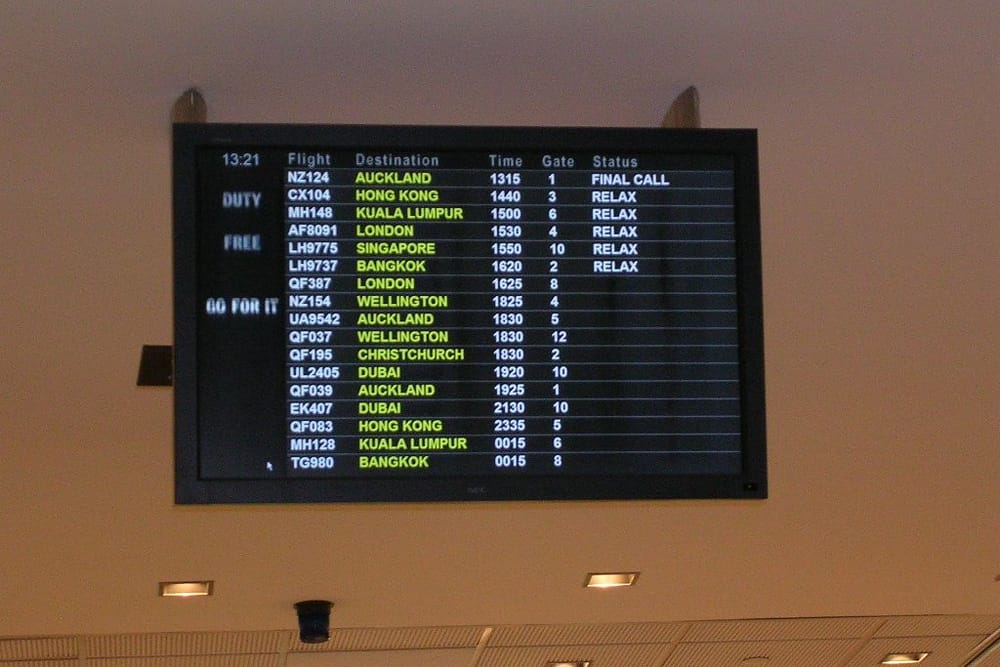
- Photograph the departure board showing the delay, and keep the boarding pass.
- Note the actual arrival time at the gate, not the wheels-down time. Compensation thresholds are measured at arrival.
- Ask about rerouting on another carrier if the delay is long. Airlines can do this and often will if asked directly.
If your bag does not arrive
A separate and much more commonly useful set of rights.
- File a Property Irregularity Report at the airline’s baggage desk before leaving the baggage hall. Get the reference number. Most later claims fail without a PIR.
- Photograph the report, the bag tag stub and the boarding pass.
- Ask what they will pay for interim essentials and keep receipts.
- A bag is delayed for up to 21 days and lost after that. Damage claims generally within 7 days, delay claims within 21.
- Liability is capped by the Montreal Convention at roughly 1,500 SDR, a little under two thousand US dollars — a ceiling on proven loss, not a payout.
This applies to essentially every international flight regardless of airline nationality, which makes it far more broadly useful than EC 261.
Claim services, and when they are worth it
Companies that pursue compensation claimsAd for a share of the money are worth considering when the airline has refused or gone silent, when the stated reason is disputable, or when you know you will not chase it for the months it can take. The trade is a percentage against a claim you would otherwise abandon.
What they cannot do is create a right that does not exist. No claim service can obtain EC 261 compensation for a Bangkok–Tokyo flight, because there is nothing to obtain. If one tells you otherwise, that is the point to stop.
When not to bother
Do not spend your evening on a claim in these cases.
- Your route is outside the rules. A non-EU carrier leaving Bangkok for a non-EU destination has no fixed-sum compensation available. Focus on the airline’s own provision and your insurance instead.
- The delay was weather, air traffic control or a security incident. Extraordinary circumstances remove the compensation even where the rule applies. The care obligations remain.
- You arrived under three hours late. Below the threshold, there is nothing to claim.
- You were rebooked and arrived near enough on time. The rule measures arrival delay, not inconvenience.
- It was a cheap domestic hop. The effort will exceed the money.
The general picture for a Bangkok departure: assume no cash compensation unless you are on an EU carrier heading to Europe, ask firmly for food and a hotel anyway, keep every receipt for an insurance claim, and file the baggage report before you leave the hall. The broader version of this, with hospitals and insurance, is in when the trip goes wrong.