Counterfeit notes: how a Thai booth checks yours, and what to do if one is refused
Article updated: 2026-09-17
Best rate USD · Bangkok: 33.24 — Superrich Thailand — Headquarter Rajdamri 1 · Sep 20, 08:58 → Details
Counterfeit currency is the one part of changing money that makes people genuinely anxious, partly because the consequences sound serious and partly because nobody explains what the counter is actually doing. In practice this is a procedural subject with a small number of sensible precautions, and the realistic risk to a tourist is not being arrested — it is being handed a bad note in change and discovering it two days later.
What happens at the window
When you push a stack of notes across, three checks run, usually within seconds.
The feel and the look. Staff at a busy counter handle thousands of notes a day and pick up a wrong one by texture before they think about it. Genuine notes have raised intaglio printing you can feel with a fingernail, and paper or polymer with a specific stiffness.
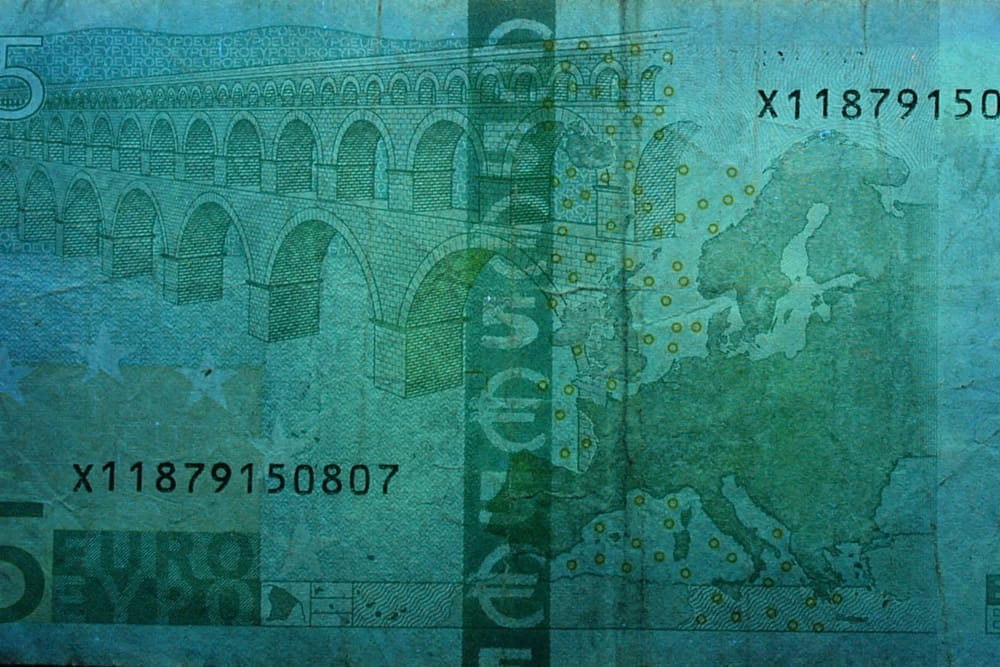
The lamp. Ultraviolet light makes security fibres and printed features fluoresce in a pattern the staff member expects. It also exposes notes that have been washed or chemically cleaned, and notes that have been bleached and reprinted at a higher denomination.
The machine. Most counters run notes through a counting machine that also authenticates — magnetic ink, infrared response, note size, and the serial number. Larger branches use a machine that reads the note more thoroughly than a human can.
For Thai baht, the features being checked are the watermark of the King visible in transmitted light, the security thread embedded in the paper, the colour-shifting ink on the denomination, the raised print, and on the polymer 20-baht note a transparent window. You do not need to memorise these. You need to know that they exist and that machines check them.
Why a refusal is usually not an accusation
Notes get handed back for reasons that have nothing to do with forgery. Torn, taped, written on, stained, faded, or in the case of US dollars printed before 2006 — all of those are refused on condition or convention, not authenticity. That is a separate subject, covered in banknotes a Thai booth will refuse.
The distinction to watch for is simple:
- The note is handed back to you. Condition, denomination policy, or the shop not wanting that series. Normal. Try another counter.
- The note is kept and someone makes a phone call. The shop believes it is counterfeit. Different situation, below.
If a note is held
Stay at the counter and stay calm. A licensed money changer in Thailand is required to retain a suspected counterfeit note and report it; the staff member is following a rule, not making a decision about you.
- Do not argue and do not try to take the note back. Reaching for it is the one thing that turns a procedural matter into a confrontation.
- Ask for a receipt or record showing the denomination and serial number of the note retained. A licensed shop can produce this.
- Explain where you got it. If it came from a bank at home, from an ATM, or as change from a named shop, say so. This is the most useful thing you can offer.
- Note the time, the shop and the branch. Take a photograph of the receipt.
- Accept that the money is gone. No country reimburses a holder for a counterfeit note. This is the single most important expectation to set: the loss falls on whoever is holding it when it is detected.
- Contact your embassy only if the situation escalates, which for a tourist with a plausible explanation it essentially never does.
If you are carrying a large amount and are worried about the conversation, change money at a large branch of an established chain rather than a small independent window. Bigger operations have a documented process and staff who have run it before.
The risk that actually applies to tourists
Being handed a counterfeit is more likely than being caught with one, and it happens in change rather than at an exchange counter. Exchange counters check what they hand out; a night market stall, a taxi driver at 02:00 or a bar does not.
The notes to look at are the Thai 1,000-baht and 500-baht. Habits that cost nothing:
- Break large notes at places that machine-count — 7-Eleven, a supermarket, a mall, a hotel. Then spend the small notes on the street.
- Look at a 1,000-baht note when you receive it. Tilt it so the colour-shifting number changes, and hold it up so the watermark appears. Two seconds.
- Be careful with change for a 1,000 at night, when you are tired and the light is bad. This is where the substitution trick lives: you hand over a genuine note, it is briefly out of sight, and a different note comes back with a story about it being refused.
- Keep the note in view. Hand it over across a counter, not to someone who walks away with it.
- Refuse a note you do not like. You can hand it straight back and ask for another. This is normal and nobody takes offence.
If you end up holding one, the honest answer is that you are out the money. Do not try to pass it on. Passing a note you know is counterfeit is the part that is actually an offence.
Which currencies attract the most scrutiny
US dollars get the hardest look. The older designs are the most forged currency in the region, which is the practical reason behind the pre-2006 convention. If you are arriving from the United States, bring recent, bank-issued notes and the whole subject evaporates.
Euros and pounds are checked but modern designs are hard to fake convincingly, and counters are confident with them.
Polymer currencies — Australian, New Zealand, Canadian dollars, and the Thai 20-baht note — are the easiest to authenticate and the least often questioned.
Thai baht going the other way is the thing to keep an eye on, because that is what you will be holding and spending for two weeks.
Who does not need to think about this
- Anyone changing bank-issued cash. If your notes came from your own bank or an ATM at home within the last few weeks, they are genuine, current-series and clean. There is nothing to check.
- Anyone on a card-only trip. Cards cannot be counterfeited in your pocket. Your issues are the flat 220-baht ATM fee, your bank’s foreign transaction charge, and declining dynamic currency conversion.
- Anyone who only ever holds 100-baht notes and smaller. Forgery concentrates in the 1,000 and, less often, the 500. Small notes are not worth anyone’s trouble to fake.
- Anyone changing money at a major branded counter in daylight. The machine has already done the work. You are not the one carrying the detection burden.
The general shape of it: use licensed shops, keep your notes clean and current, break big notes where there is a machine, glance at a thousand when you get one, and do not accept change you cannot see. Where to find licensed counters near you is on the Bangkok page and in the shop directory; what a licensed shop is required to ask you for is in passport and ID rules.