Samui, Phangan and Tao: the ferry, and a cash plan made on the mainland
Article updated: 2026-09-21
Best rate USD · Koh Samui: 32.86 — Government Savings Bank — Samui Airport exchange counters · Sep 20, 08:58 → Details
The Gulf islands — Samui, Phangan and Tao — are reached by boat, and the boat leaves from a mainland that most visitors pass through in a hurry. That hurry is where two mistakes happen: paying far more for the journey than it needs to cost, and arriving on an island with no plan for cash in a place where cash is what everything runs on.
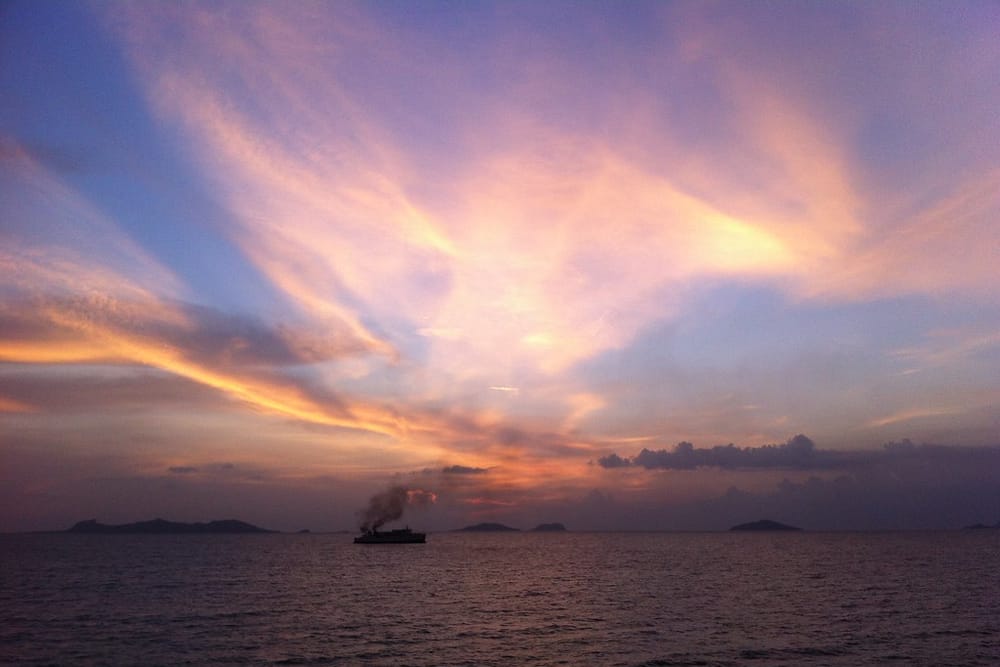
Both mistakes are avoidable from Bangkok.
Getting there
The cheap route: bus or train to Surat Thani, then the ferry. Overnight buses and trains run from Bangkok to Surat Thani. From there a shuttle takes you to the pier at Donsak, and a ferry crosses to Samui or Phangan in roughly 1.5–2 hours for about 150–300 baht per passenger. The whole thing takes 10–14 hours and is the way most budget travellers and most Thais do it.
Combination tickets. Bus-and-ferry tickets sold in Bangkok cover the whole chain for roughly 600–1,000 baht. They are convenient — one ticket, one queue, someone pointing you to the right bus at the pier — and a little dearer than assembling the pieces yourself. Sold online and at the bus terminals; check the current price and the departure time, since the overnight services are the ones that make the timing work.
Catamarans. High-speed boats run from Chumphon and Surat Thani to Tao, Phangan and Samui. They are faster than the car ferry and cost more, and they are the usual way to reach Tao. Rough seas can make the fast boats unpleasant in the wetter months.
Flying to Samui. The quickest way by far: an hour from Bangkok, and the airport is charming. The catch is that the airport’s airline has few competitors on the route, so fares run high. The common compromise is to fly to Surat Thani on a low-cost carrier and take the bus-and-ferry from there, which cuts a day off the land route for a fraction of the Samui fare.
| Route | Rough cost | Time |
|---|---|---|
| Bus or train + Donsak ferry | Ferry 150–300 baht plus the bus or train fare | 10–14 h |
| Combination ticket from Bangkok | 600–1,000 baht | 10–14 h |
| Fly to Surat Thani + ferry | Flight plus ferry and shuttle | Half a day |
| Fly to Samui | Check the current fare; it is high | 1 h flight |
On the islands themselves, a taxi or a pre-booked car from the pier or airport to the hotel is a fixed-price affair, and prices on Samui in particular run well above mainland rates. If you are arriving late or with a group, a transfer booked in advance removes the pier-side negotiation.
Why the money plan has to be made on the mainland
The islands are expensive for cash in three specific ways.
Few money changers publish rates. Bangkok has hundreds of counters competing on a board you can read from the street. Samui has a handful, Phangan fewer, Tao almost none, and most of them do not post a rate at all. The ones that do sit a few per cent below Bangkok — the island penalty that applies to everything from a coffee to a sarong. The Samui page shows which shops publish anything, and the list is short.
ATMs charge 220 baht a withdrawal. The flat fee on foreign cards applies here as everywhere, and with fewer machines and a higher cost of living you will be tempted to withdraw more often. Five withdrawals in a fortnight is 1,100 baht in fees before your own bank has added its percentage.
Phangan’s Full Moon party is cash only. So are the boat taxis, the beach bars, the bucket stalls, the motorbike rental deposit, the songthaews and most of the places you will eat. A card gets you the hotel bill and not much else.
The plan that follows is short:
- Change money in Bangkok at a competitive counter, where the spread is around 1%. The Bangkok page shows today’s boards. Surat Thani, if you pass through it in daylight, is a second chance at mainland rates.
- Carry enough for the island stay, not just the first day. For two people over a week, that is more cash than most people are comfortable holding; split it between two bags and the hotel safe.
- Ask for small notes. A 1,000-baht note is hard to break at a beach stall and impossible at a boat taxi. Ask the counter for a mix with plenty of 100s and 20s.
- Keep the card for the hotel and for one large ATM withdrawal if the cash runs out — one, not several.
A note on timing
The Gulf’s dry season runs roughly opposite to the Andaman’s, which makes these islands the sensible choice in the months when Phuket is wet. The ferries run year-round, but the fast boats and the smaller piers are the first to be affected by rough weather, and a cancelled crossing is a night on the mainland. That is one more reason to have cash in your pocket rather than a plan to withdraw it on arrival.
Who can ignore this
- Anyone flying direct to Samui to a resort that takes cards for everything and includes the transfer. You still want some cash for the beach; you do not need a strategy.
- Anyone on a long stay who will be crossing back to the mainland regularly. Change on each visit.
Everyone else — and especially anyone heading to Phangan for the party or to Tao for a dive course — sorts the cash in Bangkok, in small notes, and crosses with a full wallet and an empty to-do list.