How to read a Thai exchange rate board (and why the same currency has four prices)
Article updated: 2026-09-16
Best rate USD · Bangkok: 33.24 — Superrich Thailand — Headquarter Rajdamri 1 · Sep 20, 08:58 → Details
The boards in Thai exchange shops carry more information than most visitors read, and the part people skip is the part that costs them money.
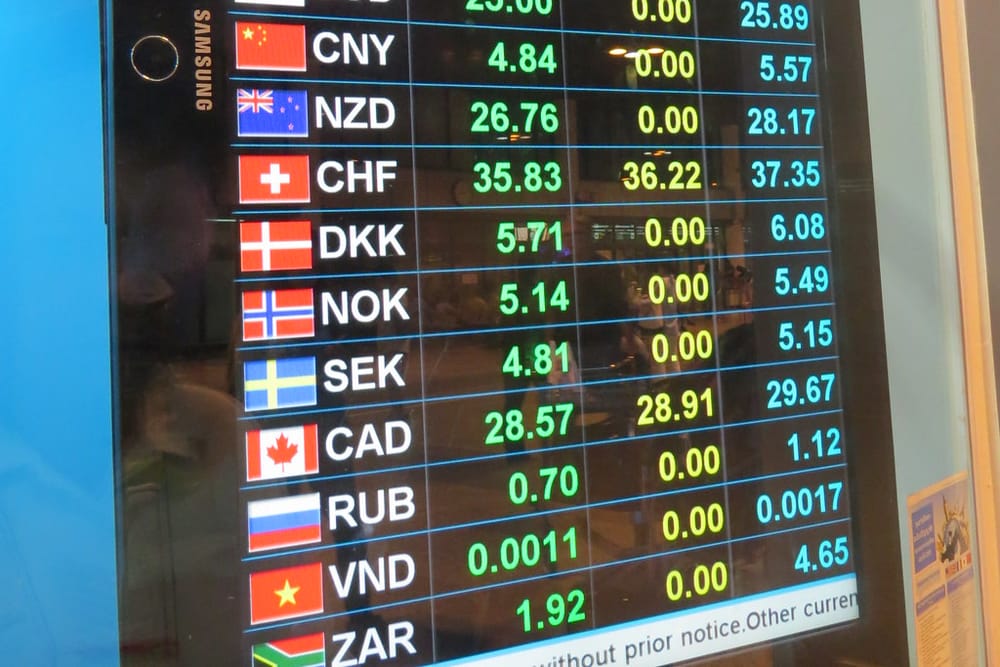
Two columns, not one
Every board has Buying and Selling.
- Buying is what the shop pays you for foreign cash. Arriving in Thailand with dollars, euros or yen? This is your column.
- Selling is what you pay to buy foreign currency with baht. Leaving Thailand with leftover baht? This is your column.
The gap between them is the shop’s margin. On US dollars at a competitive Bangkok shop it can be as little as 0.2%; on a minor currency at a quiet border town it can be 5% or more.
Four prices for one currency
This is the part that surprises people. A typical USD row does not show one number, it shows several:
| Denomination | Buying |
|---|---|
| 100, 50 | highest |
| 20, 10 | lower |
| 5 | lower still |
| 1 | lowest |
The shop has to ship small notes back to a bank, and that costs them more per dollar. So they pay you less for them. The spread between a US$100 note and a US$1 note is routinely 1–3%.
The same logic applies everywhere: ¥10,000 notes are quoted separately from ¥1,000, €500 separately from €50, and ₩50,000 separately from ₩1,000.
The practical rule: bring the largest notes you can.
What the letters mean
You will see USD(L), USD(M), USD(S) or EUR(L) on some boards. L, M and S are large, medium and small denominations — the same tiering with shorter labels.
Condition matters too
Notes that are torn, taped, heavily creased, written on, or stained may be refused or accepted at a discount. US dollars printed before 2006 are treated with particular suspicion across Southeast Asia and are often rejected outright.
Rates move during the day
Boards are updated several times a day as the interbank market moves. A rate you saw at 10:00 may be different at 17:00. Shops in competitive areas update more often than shops in quiet ones.
The one rule that never changes
Whatever you read online — here included — the board in the shop at the moment of the transaction is the only binding rate. Check it before you hand over your money, and count what you receive before you leave the counter.
THX reads the published board of every shop we track directly from that shop’s own website every few minutes, so the ranking reflects what they are quoting right now rather than what someone wrote in a blog post two years ago.