Don Mueang or Suvarnabhumi: two very different arrival days
Article updated: 2026-09-17
Best rate USD · Bangkok: 33.24 — Superrich Thailand — Headquarter Rajdamri 1 · Sep 20, 08:58 → Details
Bangkok has two airports and travellers routinely treat them as interchangeable. They are not. They sit on opposite sides of the city, they have different transport links, they have different exchange options inside them, and the mistake that costs the most — booking a tight connection between them — comes from assuming otherwise.
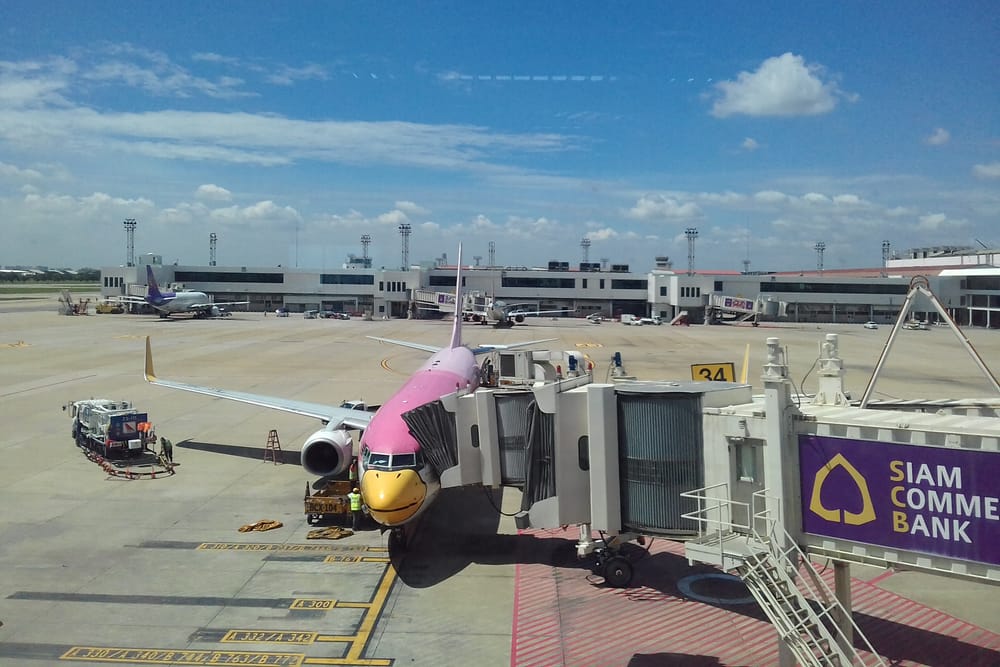
Suvarnabhumi (BKK) is south-east of the city and handles most long-haul and full-service traffic. Don Mueang (DMK) is north and is Thailand’s low-cost hub — AirAsia, Nok Air, Thai Lion, and most of the cheap regional and domestic flights. If you are flying Bangkok to Chiang Mai or Phuket on a budget fare, you are probably at Don Mueang.
The exchange situation is genuinely different
This is the difference with the clearest cash value.
Suvarnabhumi has a cheap floor, and it is on your way out. The counters in the arrival hall immediately past customs are the most expensive place in the country to change money — several per cent behind a competitive city counter. But down at level B, where the Airport Rail Link platforms are, there are counters operated by city chains that price far closer to city rates. You walk past them for nothing if you are taking the train. The arithmetic is in airport versus city rates, and current boards are on the Suvarnabhumi page.
Don Mueang has no equivalent. There is no cheap lower floor to walk down to. The rule there is simply: change the minimum you need to leave the building, and do the real exchange in the city. The Don Mueang page has what is published.
In both cases the plan is the same in shape — change 3,000 to 5,000 baht on arrival, no more — but at Suvarnabhumi there is a better window a few minutes’ walk away, and at Don Mueang there is not.
Getting into the city
From Suvarnabhumi
- Airport Rail Link to Phaya Thai, under 50 baht, about half an hour, then change to the BTS. Runs from early morning until around midnight; check the last train if you land late.
- Public taxi from the stand on level 1. Meter, plus a 50-baht airport surcharge, plus expressway tolls you pay in cash along the way. Central Bangkok typically works out around 350–500 baht all in. Ignore anyone who approaches you inside the terminal offering a flat fare.
- A pre-booked transferAd, which costs more but is fixed in advance and waits for a late flight.
From Don Mueang
- A1 and A2 buses to Mo Chit, about 30 baht, paid on board. Simple, frequent, and the cheapest way in.
- SRT Red Line commuter train to Krung Thep Aphiwat central station, from where the MRT continues into the city. Fast and inexpensive; check the current fare.
- Public taxi from the stand outside the terminal on level 1, with the same 50-baht surcharge and the same rule about using the meter. Don Mueang is closer to the northern half of the city than Suvarnabhumi is, so a run to Sukhumvit costs roughly what it does from Suvarnabhumi while a run to Ari or Chatuchak costs less. Traffic on Vibhavadi Rangsit matters more than distance.
There is a pattern worth noticing. Don Mueang’s cheap options are good if your hotel is in the northern or central part of the city. Suvarnabhumi’s train is good if your hotel is near a BTS station in the Sukhumvit or Silom corridor. Both airports are bad value if your hotel is somewhere the train does not reach and you arrive in rush hour.
The connection between them
This is the one that ruins days. There is no airside transfer between Don Mueang and Suvarnabhumi. They are separate airports roughly 45 km apart, and moving between them means leaving one, crossing Bangkok on the surface, and checking in again from scratch.
A free shuttle bus runs between the two terminals for passengers holding an onward ticket; check the current conditions, because they change. Journey time is heavily traffic-dependent and can be an hour or well over two.
If you have booked a long-haul arrival at Suvarnabhumi and a budget domestic departure from Don Mueang on separate tickets, allow far more time than seems reasonable. Four hours is not paranoid. And be clear that separate tickets mean you carry the risk yourself: if the first flight is late, the second airline owes you nothing.
Terminal shape and what it does to your first hour
Suvarnabhumi is one enormous terminal. Immigration queues can be long at peak arrival banks, particularly late evening when several long-haul flights land together. Walking distances are substantial. Budget an hour from wheels-down to the kerb if you have checked bags, more at a bad hour.
Don Mueang has two terminals, with international arrivals in Terminal 1 and domestic mostly in Terminal 2, connected on foot. It is smaller and usually faster to get out of, but it has fewer facilities and the arrivals area gets crowded when several low-cost flights land at once.
Landing late
Don Mueang takes a lot of late-night low-cost arrivals. Suvarnabhumi takes late long-haul. At either, after about 22:00 the trains thin out or stop, the taxi queue lengthens, and driver willingness to use the meter drops. That is the case for pre-booking a ride, and it is the whole subject of landing after midnight.
The plan, in short
- Have data before you land. An eSIM installed at homeAd, switched on after landing, so you can call a ride and show a driver an address. Options priced out in eSIM versus the airport SIM counter versus roaming.
- Change a small amount in the terminal. At Suvarnabhumi, walk down to level B first if you are taking the train.
- Pick your ride by the hour and your luggage, not by habit. Train in daylight and travelling light; metered taxi otherwise; a booked transfer late at night, with a group, or going somewhere awkward.
- Never accept a flat fare from someone who approaches you inside the building.
- Do the real exchange in the city tomorrow, using the Bangkok page to see what counters near your hotel are quoting.
Who does not need any of this
- Anyone transiting without clearing immigration. If you are connecting airside at Suvarnabhumi, you are not entering Thailand, you do not need baht, and the only thing that matters is your gate.
- Anyone met by a hotel or company car. Your ride is arranged and your first hour is decided. Change a token amount for tips and water and go.
- Anyone arriving with baht already. If you changed money at home or have baht left from a previous trip, skip the arrival counters entirely.
- Anyone landing at Don Mueang mid-morning with cabin bags and a hotel near a station. Take the A1 or the Red Line, change money in the city, and stop reading. Pre-booked transfers, airport counters and contingency plans are for late arrivals, heavy luggage, groups and awkward destinations — not for a straightforward daylight landing.